
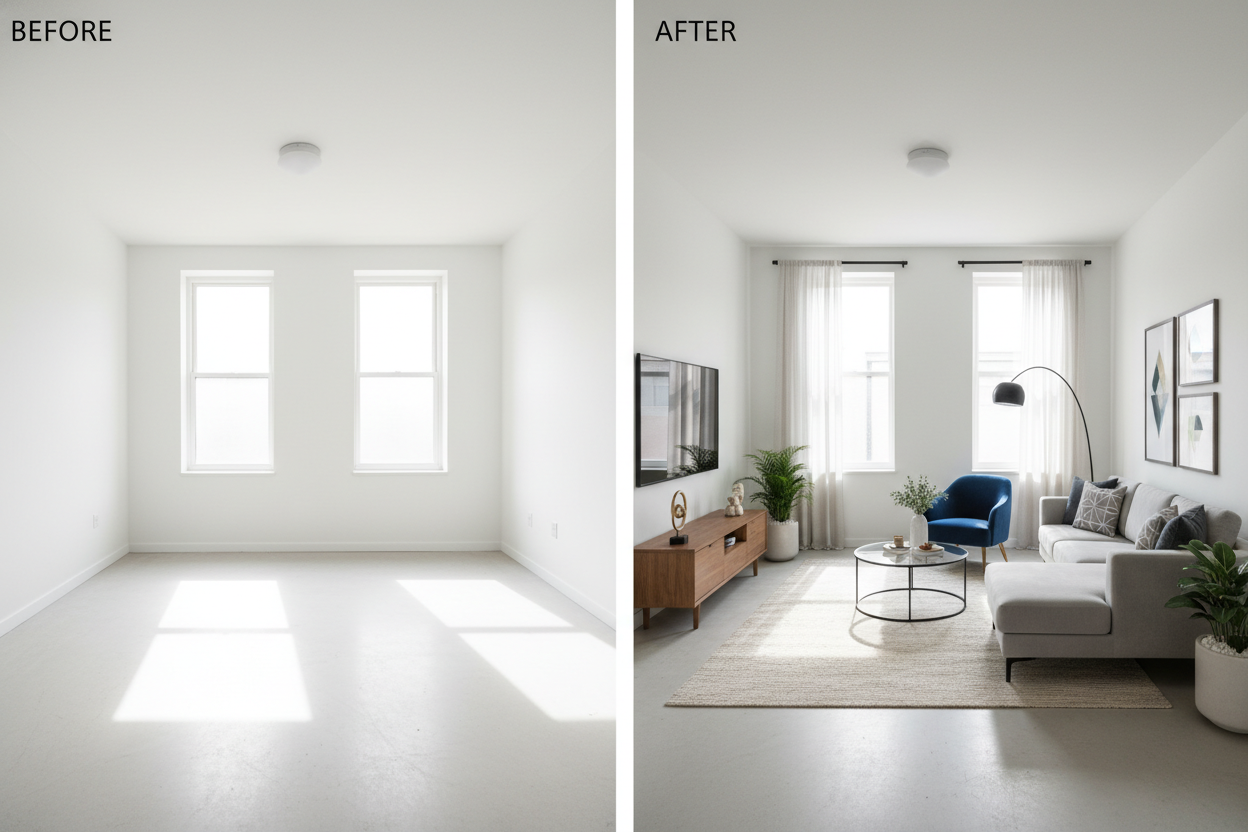
You upload a photo of an empty room. Twenty seconds later, you're looking at a fully furnished living space with a linen sofa, warm pendant lighting, and a gallery wall that somehow matches the architecture perfectly. No designer. No furniture truck. No invoice for $3,000.
Most people just call it "AI magic" and move on. But if you're a real estate professional betting your listing's first impression on this technology, it helps to understand what's actually going on — and why the output quality varies so much between platforms.
Step 1: The AI Reads Your Room
Before any furniture appears, the AI needs to understand the space. This means analyzing the uploaded photo for:
- Room geometry — wall angles, floor plane, ceiling height, corners, and perspective
- Lighting conditions — where natural light enters, shadow direction, color temperature
- Existing elements — architectural features like fireplaces, built-ins, windows, and doors that must be preserved
- Room type — living room, bedroom, kitchen, dining room — each has different furniture logic
This is where low-quality AI tools fall apart. If the model misreads the floor plane or perspective, furniture ends up floating in mid-air or scaled completely wrong. Good AI gets this right consistently, even with imperfect photos.
Step 2: Style Selection Guides the Generation
Once the room is understood, the staging style you choose — Modern, Scandinavian, Coastal, Mid-Century, and so on — acts as the creative brief. The AI has been trained on thousands of interior design examples per style, so it knows what furniture pieces, color palettes, textures, and layouts belong together.
With Stagerify, you pick the style before the AI runs. That single input changes everything: the sofa profile, the rug pattern, the artwork, the decorative accents. The same empty room can look like a Copenhagen apartment or a California beach house depending on your selection.
Step 3: Image Synthesis — Where the "Magic" Happens
This is the core step, and it's where the technology gap between platforms is widest. Modern AI virtual staging uses diffusion models — the same class of technology behind the most advanced image generators — to synthesize furniture and decor directly into the photograph.
The model doesn't paste furniture clipart onto your image. It regenerates the entire scene with furniture baked in, matching the original photo's lighting, perspective, and texture. This is why a well-executed virtual staged photo looks indistinguishable from a real one: the AI is rendering light bouncing off the sofa fabric and hitting the hardwood floor the same way real light would.
The architectural features identified in Step 1 are preserved and protected throughout this process — windows stay in place, the fireplace doesn't disappear, and molding details remain intact.
Step 4: Furniture Removal (When You Need It)
Not every listing starts with an empty room. When a property has existing furniture — outdated, cluttered, or just not photogenic — AI can remove it before staging. This is a separate but equally sophisticated step: the model identifies what's furniture versus what's fixed architecture, removes the furniture, and intelligently fills in the now-empty space (floors, walls, baseboards) before the staging pass begins.
Stagerify handles both in a single workflow. You can flag a photo for furniture removal and re-staging in one request, and the AI handles both steps automatically.
Why Results Still Vary — And How to Get Them Right
AI virtual staging is powerful, but photo quality still matters. The best results come from:
- Wide-angle shots that show the full room, not just a corner
- Good natural light — bright, evenly lit rooms give the AI more to work with
- Straight-on angles rather than extreme diagonal perspectives
- High resolution — the AI preserves detail it can see; blurry inputs produce blurry outputs
When these conditions are met, AI virtual staging produces results that consistently outperform what most physical staging companies can deliver — at a fraction of the cost and in seconds instead of days.
The technology has moved fast. What felt like a novelty two years ago is now a core part of how serious real estate professionals bring listings to market. Understanding how it works helps you use it better — and helps you explain the results confidently to sellers who've never seen it before.