
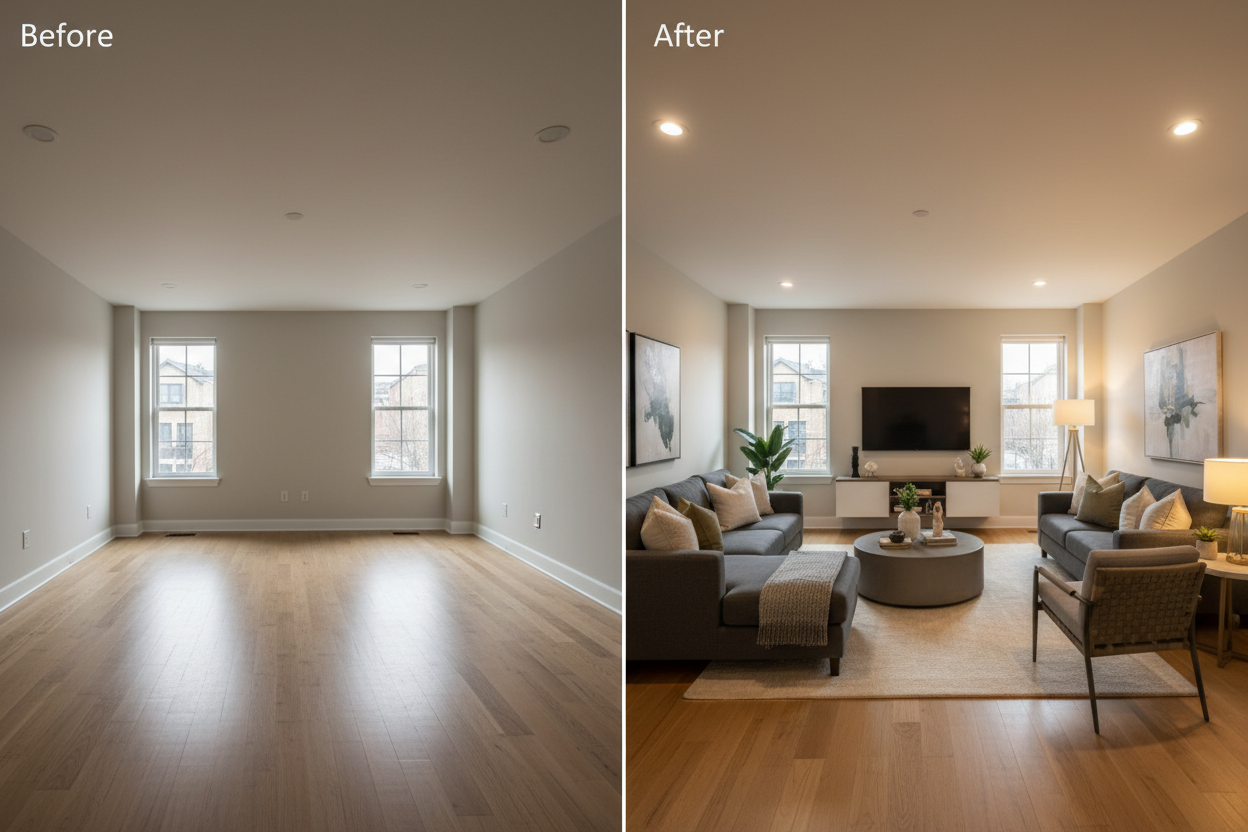
Every agent has had the conversation: the seller doesn't want to spend money on staging. The home is already "nice." Why bother? The answer, when you look at the data, is straightforward — but it requires reframing the question from "how much does staging cost?" to "how much does not staging cost?"
What Staged Listings Actually Earn
The National Association of Realtors consistently reports that staged homes sell for 1–5% more than comparable unstaged properties. On a $500,000 home, that range is $5,000–$25,000. For a $1M property, it's $10,000–$50,000.
Beyond sale price, staged homes spend significantly fewer days on market. Fewer days on market means fewer carrying costs for sellers — mortgage payments, insurance, utilities, and property taxes that accumulate while a listing sits. A home that sells in 2 weeks instead of 8 saves the seller real money even before accounting for the higher offer price.
Traditional Staging: High Upside, High Cost
Physical staging typically runs $1,500–$5,000 per month for furniture rental, delivery, setup, and teardown. For a property that takes two months to sell, you're looking at $3,000–$10,000 before a single offer comes in — with no guarantee of recouping it.
This is why staging has historically been a tough sell for lower and mid-price properties. The ROI math only works clearly at higher price points where the 1–5% gain outweighs the staging cost by a comfortable margin.
Virtual Staging Changes the Equation
AI-powered virtual staging costs a fraction of physical staging — and delivers results in hours instead of days. The economics shift dramatically:
- Cost: A fraction of traditional staging, per image
- Speed: Photos ready the same day you shoot
- Flexibility: Try multiple styles without additional cost
- No logistics: No movers, no rental agreements, no scheduling
For a $300,000 property where physical staging might feel hard to justify, virtual staging makes the ROI obvious. Even a conservative 1% lift on a $300K sale is $3,000. The break-even point is essentially zero.
The Hidden Cost: Buyer Perception
What the ROI numbers don't fully capture is the compounding effect of buyer perception over time. A listing that generates strong interest in week one creates competition — and competition drives offers up. A listing that sits generates skepticism — and skepticism drives offers down.
Staging's biggest ROI isn't just the final sale price. It's the first-week momentum that prevents price reductions from ever becoming necessary. A $15,000 price cut is far more expensive than staging ever was.
How to Think About It Going Forward
With Stagerify, the question is no longer whether to stage — it's which style to use. Upload your listing photos, select a staging style that fits the property and the buyer demographic, and have polished, buyer-ready images in your hands the same day. If the first style doesn't feel right, revisions are built in.
The ROI of virtual staging isn't a gamble. It's arithmetic.