
You know the listing. A small living room stuffed with a sectional that doesn't fit, mismatched side tables, and a TV stand that blocks half the window. Buyers walk in and immediately think: too small. The reality? The room was never the problem. The staging was.
Small living rooms are everywhere — condos, starter homes, urban apartments. Stage them right and buyers see cozy and livable. Stage them wrong and they see cramped and overpriced. The difference comes down to a handful of decisions.
1. Edit Down to the Essentials
The number one mistake in small living rooms is too much furniture. Every piece you add makes the room feel smaller. For a compact space, you need exactly three things: a sofa, a coffee table, and one accent chair or side table. That's it.
- Remove anything that doesn't serve a clear purpose
- Ditch the entertainment center — mount the TV on the wall or skip it entirely
- Eliminate floor lamps that eat up walking space — use wall sconces or table lamps instead
When in doubt, take it out. Buyers can always imagine adding furniture. They can't mentally remove the clutter that's already there.
2. Choose the Right Furniture Scale
Oversized furniture is the fastest way to shrink a room. A sectional that seats six doesn't belong in a 200-square-foot living room — even if the sellers love it. Scale matters more than style.
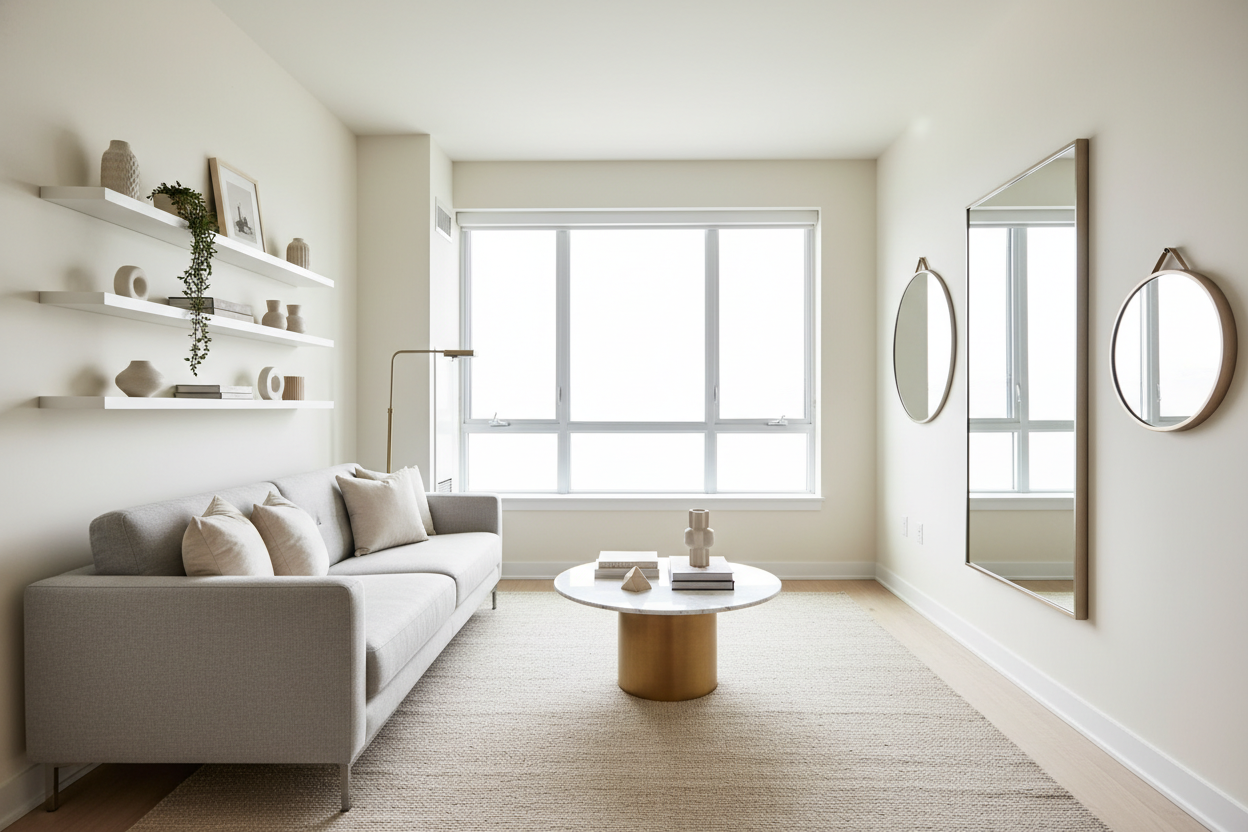
Look for low-profile sofas with exposed legs — they create visual breathing room by showing floor space underneath. A sofa that sits flush to the ground visually eats the floor. One with four legs appears to float, making the room feel larger. Apply the same thinking to your coffee table: clear glass or open-frame designs work far better than solid wood blocks.
3. Use Light and Mirrors Strategically
Natural light is your biggest ally in a small space. Stage around it — pull curtains all the way to the wall edges, not just to the window frame. This tricks the eye into thinking the windows (and the room) are wider than they are.
A large mirror opposite a window doubles the perceived depth of the room instantly. It also reflects light, making the space feel brighter without adding any physical square footage. This is one of the highest-ROI staging moves you can make in a small living room — and it costs almost nothing.
For paint, stick to soft whites and warm neutrals. A dark accent wall in a small room looks dramatic in design magazines but makes buyers hesitant in person.
4. Create a Clear Focal Point
Small rooms feel chaotic when there's no visual anchor. Pick one focal point — a fireplace, a window with a view, or a styled accent wall — and arrange everything else around it. This gives the eye a place to land and makes the room feel intentional rather than cramped.
Avoid the temptation to decorate every surface. A single styled shelf beats three cluttered ones. Two art pieces with breathing room between them beat a gallery wall that competes for attention.
5. Stage It Virtually Before You Spend a Dollar
Here's the practical problem: most sellers don't have a spare low-profile sofa or a perfectly scaled accent chair sitting in their garage. Sourcing, renting, or buying staging furniture for a small living room costs hundreds — sometimes thousands — of dollars.
That's exactly what virtual staging solves. With Stagerify, you upload a photo of the empty (or cleared) room, choose a style and furniture set, and get a photorealistic staged version back in seconds. You can test different layouts, furniture scales, and color palettes without moving a single piece. Once you know what works, you can decide whether to source a few physical pieces or simply use the virtual images for your MLS listing.
For small spaces especially, the ability to try before you buy isn't just convenient — it's the difference between a room that photographs well and one that doesn't.
Small living rooms aren't a liability. With the right staging approach, they're a feature — intimate, efficient, and easy to maintain. Give buyers a room that feels considered rather than cramped, and the square footage stops being the story.