
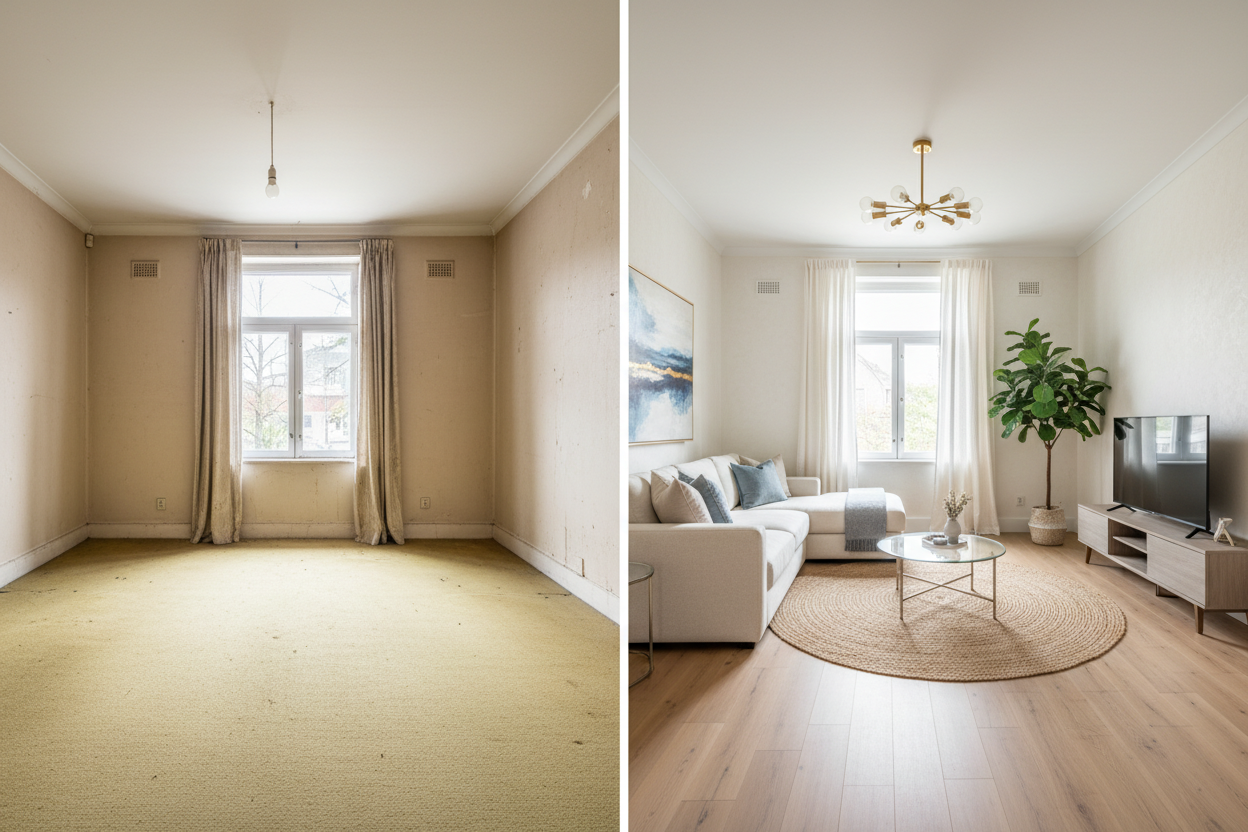
Every agent has had this listing: solid bones, great location, but the kitchen looks like 1997 called and wants its laminate back. You know buyers will see past it — but buyers scrolling Zillow at midnight don't give it that chance. They swipe on to the next listing.
That's the gap virtual renovation fills. It's not just staging furniture in an empty room. It's showing buyers what a property genuinely could look like — updated flooring, fresh paint, modern cabinetry, new fixtures — all rendered photorealistically from a single photo. No contractors, no permits, no weeks of waiting.
What Virtual Renovation Actually Means
Virtual staging adds furniture to empty rooms. Virtual renovation goes a step further: it changes the surfaces themselves. Think new hardwood floors replacing worn carpet, white shaker cabinets where dated oak once lived, a subway-tiled backsplash swapped in for old laminate. The room structure stays the same — the finishes transform.
AI makes this possible at scale. Instead of hiring a CGI artist to painstakingly redraw every surface (a process that used to cost thousands and take days), modern diffusion models can reinterpret materials, colors, and fixtures in seconds while preserving realistic lighting and perspective. The result looks like a professional renovation photo, not a Photoshop job.
Why It Moves the Needle for Buyers
Most buyers lack spatial imagination. Studies consistently show that people struggle to mentally remodel a space — they respond to what they see, not what they're told is possible. "Just picture it with new floors" doesn't work. Showing them a photo of new floors does.
Virtual renovation removes the mental labor. Buyers see the finished vision instantly, which means:
- Less hesitation — they're not projecting risk onto a dated interior
- Fewer lowball offers — buyers price in renovation costs they can clearly see won't be as dramatic as feared
- More emotional connection — it's easier to fall in love with a space you can already picture living in
- Faster decisions — visual clarity accelerates the buying process
The Listing Types That Benefit Most
Not every property needs virtual renovation, but certain listings unlock dramatically more value from it:
- Fixer-uppers and estate sales — show the upside without requiring buyers to imagine it
- Dated but structurally sound homes — great layouts buried under 20-year-old finishes
- Investment properties — help investors instantly visualize post-renovation ARV (after-repair value)
- New builds with unfinished interiors — let buyers see finish options before committing
- Off-market or pre-listing properties — generate buyer interest before the work even begins
For agents presenting fixer-uppers, virtual renovation photos can be the difference between a buyer walking away and a buyer making an offer with renovation confidence baked in.
How Stagerify Handles the Before-and-After Workflow
With Stagerify, virtual renovation starts with the same workflow as virtual staging: upload your photo, let AI remove existing furniture or clutter, then select a style. The difference is in what you're transforming — not just furnishings, but finishes and surfaces.
The AI analyzes the room's geometry, lighting direction, and existing materials, then renders the new surfaces in a way that respects the original perspective and shadows. What comes back isn't a flat overlay — it's a cohesive, photorealistic image that holds up to close inspection.
You can run multiple style variations in minutes. Show a buyer the same kitchen in a modern white finish and a warm wood-toned finish. Let them choose. That kind of personalization used to require a custom CGI quote and a two-week turnaround. Now it takes seconds.
What This Means for Real Estate Marketing in 2026
The agents winning listings today aren't just taking better photos — they're presenting a more compelling vision of what a property can become. Virtual renovation is quickly becoming a standard tool in that presentation, especially in markets where inventory is tight and buyers are comparing dozens of listings at once.
The cost of not using it is showing buyers a dated room and hoping they see past it. The cost of using it is a few minutes on Stagerify. The math isn't complicated.
Physical renovation costs tens of thousands of dollars and takes months. Virtual renovation costs a few dollars and takes seconds. For marketing purposes — which is all listing photos are — that's not even a contest anymore.