
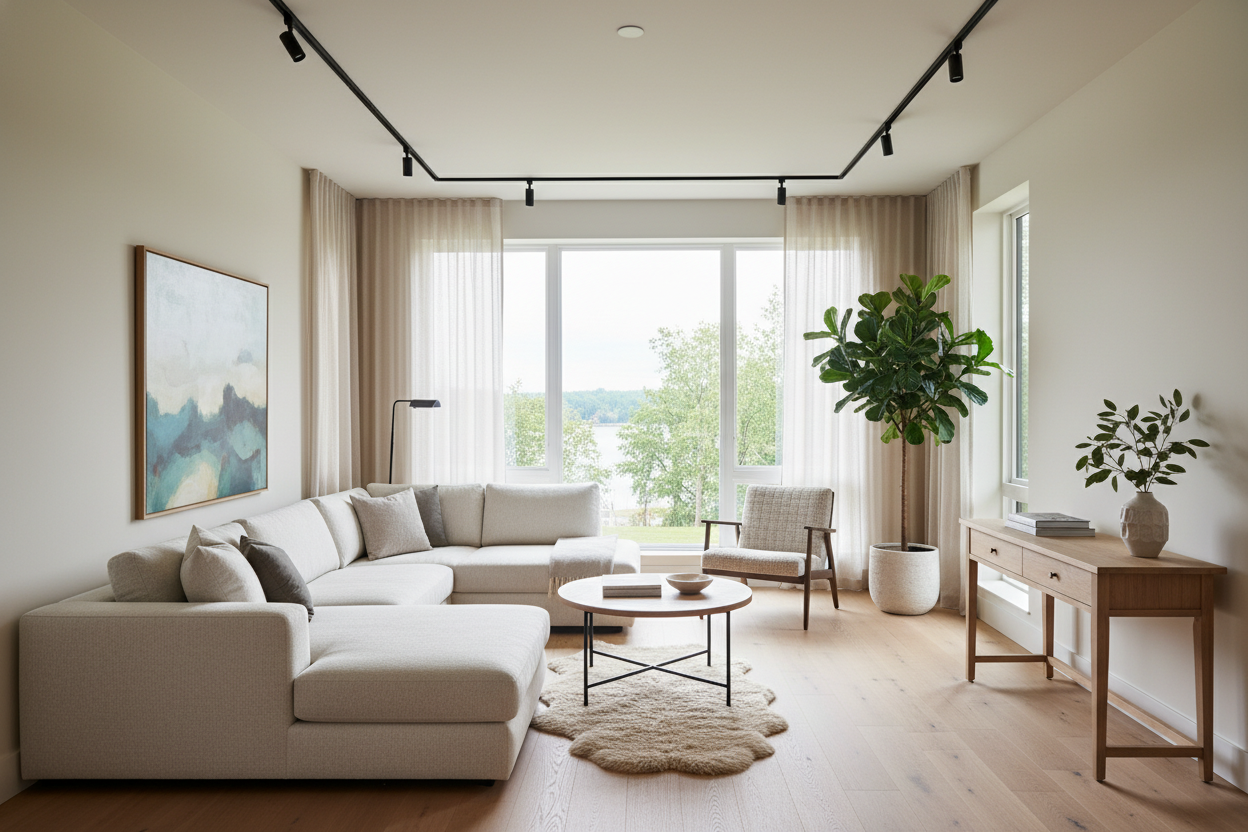
Selling pre-construction has always been a game of imagination. You're asking buyers to commit serious money to empty concrete floors and architect's drawings. The traditional solution — a physical model suite — costs $80,000 to $200,000 to build and can only show one configuration at a time. That's a brutal constraint when you have 40 unit types to market.
AI virtual staging has changed the math entirely. Developers are now producing photorealistic interiors for every floor plan variant in a single afternoon, at a fraction of the cost. Here's what that looks like in practice — and why it converts.
The Pre-Construction Buyer's Core Problem
Buying off-plan requires an enormous leap of faith. Buyers need to visualize a finished home from a floor plan PDF — and most people simply cannot do that. The result? Hesitation. Long decision cycles. Deals that fall through because the buyer "couldn't picture it."
The more vividly you can show the finished product, the faster buyers commit. This is not a hunch — it's the same psychology that drives model suites to sell surrounding units faster than anything else on a project. Virtual staging delivers that same visual proof without the six-figure build-out.
What AI Virtual Staging Enables for Developers
With a tool like Stagerify, you can generate photorealistic staged interiors from architectural renderings or construction-phase photos. The practical advantages for pre-construction sales are significant:
- Multiple configurations, instantly. Stage the same floor plan in modern, Scandinavian, and coastal styles so buyers can pick the look they connect with — no reshoots, no restagings.
- Unit-by-unit marketing. Show the corner unit with its extra windows. Show the studio laid out two different ways. Buyers browsing online get images specific to the unit they're considering, not a generic placeholder.
- Phased content at every construction milestone. When the structure is up and rough interiors are visible, photograph the shells and stage them digitally. Buyers see progress without waiting for finishes.
- Lower sales office overhead. Instead of one expensive model suite, equip your sales team with a tablet showing AI-staged images for every unit type. The conversation becomes visual immediately.
How to Generate Pre-Construction Staged Images
The workflow is simpler than most developers expect. You have two good options depending on your project stage:
Option 1 — From architectural renders. If you have 3D renders from your architect, upload them directly to Stagerify. The AI reads the spatial layout and adds furniture, lighting, and decor that fits the proportions of the room. You get a staged image that matches your actual floor plan geometry.
Option 2 — From construction photos. Once drywall and flooring are in, photograph the empty shells under good natural light. Upload to Stagerify, choose your style, and generate finished-room visuals in seconds. This approach produces the most realistic results because you're working with the actual space — real window positions, real ceiling heights, real light behavior.
Either way, you can generate multiple style variants from the same source image and revise from existing edits if you want to swap out furniture or adjust the feel.
What Converts Buyers: Specificity Over Perfection
The biggest mistake developers make with pre-construction marketing imagery is generic aspiration. Stock photos of luxury penthouses mean nothing to a buyer trying to picture their life in Unit 4B on the 12th floor.
Specificity converts. Show the buyer their exact unit, staged the way it will actually look at their square footage, with their floor plan's window placement and natural light. That level of specificity is now achievable — and affordable — with AI staging. A developer can produce unique staged images for every floor plan variant in a single day and deploy them across their website, digital ads, and sales presentations before the building is half-finished.
The Competitive Advantage Is Already Shifting
Forward-thinking developers are already treating AI virtual staging as a standard part of the pre-sales toolkit — not a novelty. Projects that show buyers photorealistic, unit-specific interiors are closing reservations faster and with fewer contingencies than those still relying on generic renders and floor plan PDFs.
If you're launching a new development and your marketing package doesn't include staged interiors for every key unit type, you're leaving reservations on the table. The tools to fix that cost less than a single afternoon of a physical stager's time.