
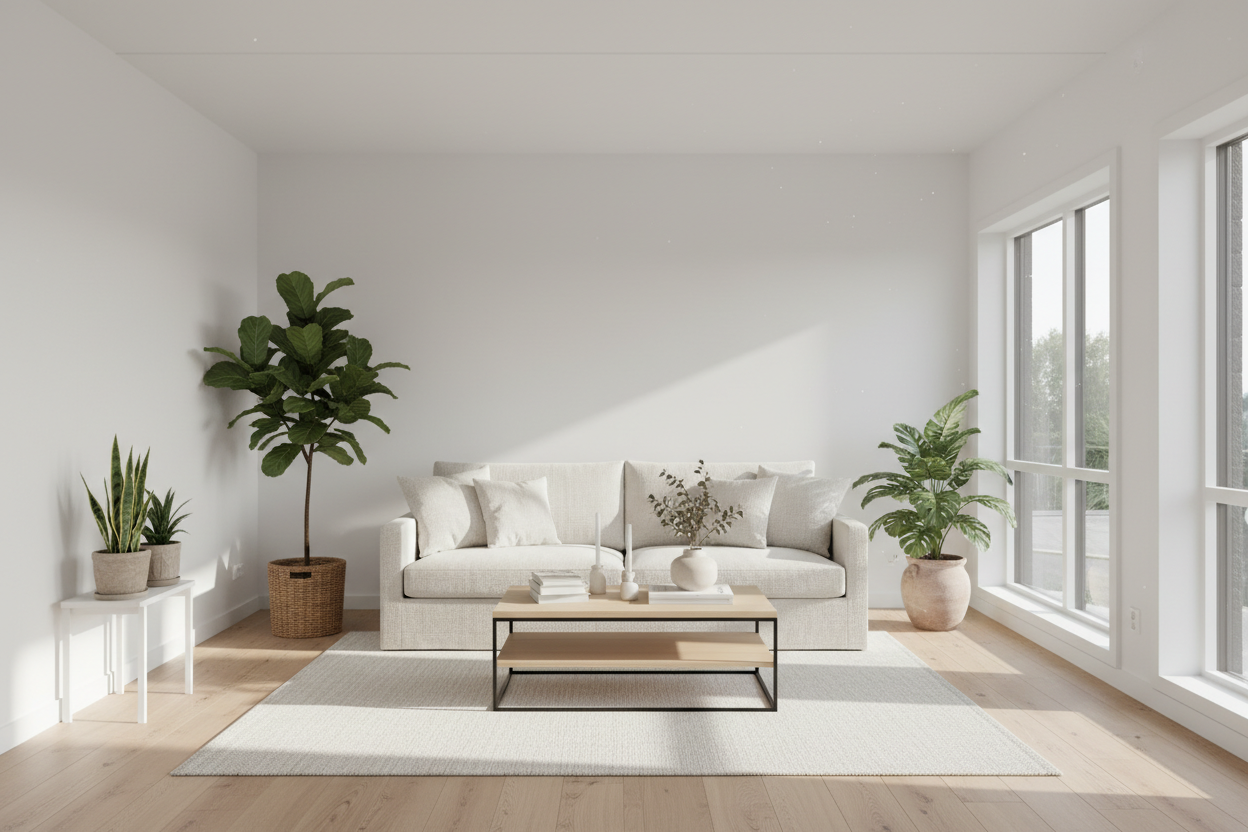
You've seen it happen: a perfectly good property sits on the market for weeks, collects a price reduction, and finally closes well below ask. Strip away the noise and you'll often find the same culprit — the home was vacant when it hit the MLS.
This isn't anecdotal. Studies consistently show that staged homes sell faster and for more money than empty ones. The gap can reach 5–10% of list price. On a $500,000 home, that's up to $50,000 left on the table simply because buyers couldn't picture themselves living there.
Empty Rooms Feel Smaller — and Cheaper
Counterintuitive but true: vacant rooms read as smaller to buyers, not larger. Without furniture to establish scale, a generous 14×16 bedroom looks like a storage closet in listing photos. Buyers unconsciously anchor their offer to their perception of the space — and that perception drops when rooms feel cold and undefined.
Takeaway: scale matters. Furniture doesn't just fill a room; it proves the room is worth filling.
Buyers Can't Emotionally Connect to Bare Walls
Real estate is an emotional purchase masquerading as a rational one. Buyers need to see themselves in the space — morning coffee at the kitchen island, movie nights in the living room. An empty house gives them nothing to latch onto. Instead of imagining their life there, they start cataloguing every imperfection: the scuff on the baseboard, the dated light fixture, the awkward alcove.
Staged homes short-circuit that critical inner voice. A well-placed sofa and a reading lamp turn a boxy room into a place someone wants to be.
Days on Market Compound the Problem
Every day a vacant listing sits unsold, buyer perception worsens. Shoppers wonder: what's wrong with it? The longer it lingers, the more negotiating leverage shifts to the buyer. By day 30, you're likely fielding lowball offers — not because the home isn't worth more, but because perception has calcified.
Staging breaks the spiral before it starts. Listings with strong visual presentation generate more showings in the first week, which is when competition is highest and offers are strongest.
Physical Staging Is Expensive. Virtual Staging Isn't.
Traditional staging can run $2,000–$5,000 per month — furniture rental, delivery, setup, teardown. For a vacant investment property or a seller who's already moved out, that's a hard pill to swallow before the home has even sold.
Virtual staging removes that barrier. With Stagerify, you upload your listing photos, choose a style — modern, mid-century, Scandinavian — and get photorealistic staged images back in seconds. If the furniture placement isn't quite right, request a revision. No movers, no rental agreements, no waiting.
For listings with existing furniture that doesn't photograph well, Stagerify's furniture removal feature clears the room digitally first, so you're staging from a clean slate. The result: listing photos that compete with luxury properties, at a fraction of the cost.
The Fix Is Faster Than You Think
You don't need to delay a listing to get it staged. With virtual staging, photos can be ready the same day you shoot the property. That means you can hit the MLS with polished, buyer-ready images on day one — when interest peaks and competition is fiercest.
- Upload your property photos
- Select your staging style and room type
- Receive photorealistic staged images in seconds
- Request free revisions until the look is right
Vacant homes don't have to be a liability. With the right presentation, they become a blank canvas — and buyers pay a premium for possibility.